
Learn what documents need consular legalisation, when notarisation and an apostille are required, and how to prepare UK papers for use abroad correctly.

Business Documents for Foreign Branches Explained
Prepare business documents for foreign branches correctly, from board resolutions and powers of attorney to notarisation, apostilles and legalisation.

7 Top Mistakes in Document Legalisation
Avoid the top mistakes in document legalisation, including wrong routes, missing certification and poor timing, before overseas documents are rejected.

How to Obtain an Apostille for a Birth Certificate
Learn how to obtain apostille for birth certificate use abroad, from choosing the right certificate to FCDO legalisation, translations and urgent deadlines
Identity Documents Accepted by Notaries in the UK
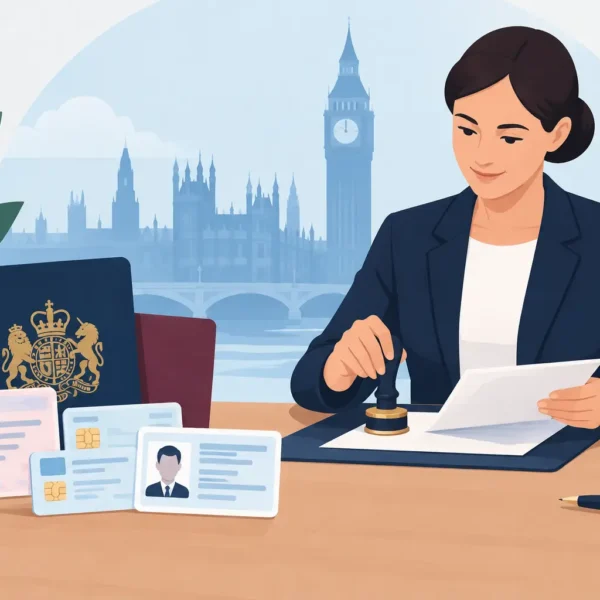
Learn which identity documents accepted by notaries can support your appointment, why originals matter, and how to avoid delays with overseas paperwork.

Does an Apostille Expire Abroad? What to Know
Does apostille expire abroad? Usually the certificate does not, but overseas authorities may reject an older underlying document. Learn to avoid delays.

Guide to Corporate Document Legalisation
A guide to corporate document legalisation for UK companies: understand notarisation, apostilles and consular steps to avoid overseas delays and rejection

When Consular Legalisation Is Required Abroad
Understand consular legalisation for UK documents, when it follows an apostille, and how to avoid delays with overseas authorities and embassies overseas.

Apostille Delay Prevention: Avoid Costly Hold-Ups
Practical apostille delay prevention for UK documents: identify errors early, plan notarisation and legalisation, and meet overseas deadlines confidently.

Corporate Apostille Documents for Overseas Use
Corporate apostille documents explained: learn which company records need notarisation, apostille or legalisation before use overseas with confidence.


White Horse Solicitors & Notary Public
96 White Horse Lane
London E1 4LR
Parking
Private Car Park Bays for clients at the rear of our Office
Bus
The 25, 309 and 205 buses run closest to our Office
Nearest Tube Station:
Stepney Green Underground tube station – (District Line) – (1 minute walk to our Office)
Mile End and Whitechapel Underground Tube Station – (Central Line) – (7 – 10 minutes walk to our Office)


OUR REVIEWS
 White Horse Notary Public London
96 White Horse Lane, London
-
I cannot rate White Horse Notary highly enough.
Muhammad Karim is incredibly professional, friendly, knowledgeable and skilled.
From my initial phone call he couldn't have been more supportive and helpful.
My self declaration was notarized … More and apostilled with great efficiency and promptness.
The gentleman on reception is also extremely friendly and welcoming.
Take my advice. If you need a notary then it should always be White Horse of course. -
Exceptional service from start to finish. The notarial team at White Horse Solicitors & Notary Public demonstrated professionalism, efficiency, and flexibility when handling a time-sensitive international matter. They provided clear guidance, … More adapted quickly to changing requirements, and facilitated remote verification with ease.
The process was seamless—from initial contact and video witnessing to prompt delivery of the notarised document and follow-up with courier details. Communication was courteous and timely throughout, and all actions were executed with precision.
Highly recommended for anyone in need of reliable and responsive notarial services, especially under tight deadlines or international constraints. -
I had a fantastic experience with White Horse Notary Services, specifically with Muhammad, who handled the notarization of my mortgage documents for South Africa. From the initial phone call, the team was incredibly helpful and friendly. … More I needed an urgent appointment, and they were able to accommodate me the very next day, which was a huge relief.
Given the volume of documents, I was also very grateful for the generous discount offered.
Thanks to White Horse, my mortgage process was significantly smoother. They played a crucial role in ensuring all my documents were correctly finalized. I recommend White Horse Notary Services to anyone needing reliable and efficient notary services.



Muhammad Karim
Notary Public
Muhammad Karim is both a qualified Solicitor & Notary Public. Muhammad Karim qualified as a Solicitor in 2012 & was awarded the post graduate Diploma in Notarial Practice from the University College London (UCL) & qualified as a Notary Public in 2015.
FAQ’S
What is the role and duty of a Notary Public?
Can a Notary Public notarise documents in foreign languages?
Who do you provide your notarial services to?
What is an Apostille & do I need it?
Do you provide same day legalisation services?
Can a Notary Public Notarise a Document Online?
What is the role and duty of a Notary Public?
A Notary Public (also referred to as a ‘Public Notary’ or simply as a ‘Notary’ is a public officer & is a specialist lawyer authorised to witness, authenticate or certify documents for use in countries around the world. Solicitors & Barristers in the UK owe a duty of care towards their clients. In contrast a Notary Public owes a duty of care to the document he is notarising.
Can a Notary Public notarise documents in foreign languages?
The short answer is yes. In certain instances it may be necessary to change a lettered translation of the document into English. Our Notary Public can advise you on whether this is required – If this is required the Notary can assist with obtaining a certified translation. If you do require notarisation of a document which is in a foreign language, please do contact our Notary Public & he will be happy to explain any specific requirements.
Who do you provide your notarial services to?
We provide notarial services to both our individual & business clients. We have years of experience in accommodating the needs of both of our individual & corporate institutions. Please visit our pages for ‘Services for Individuals’ & ‘Services for Businesses’ for more details.
What is an Apostille & do I need it?
An Apostille is a certificate issued by the foreign or commonwealth office in the UK & is the authentication of a document for use in another country.
The Apostille certificate confirms the signature, seal & stamp of the Notary Public to be genuine so that it is accepted when presented in another country outside the UK. The Apostille assures that any documents fraudulently ‘notarised’, purporting to be a Notary Public is not recognised & therefore reduces the risk of fraudulent documents being circulated around the world.
If the document being notarised is to be received by a country that is a signatory to the Apostille convention of 1961 – it is likely that you will require an Apostille. The purpose of the Hague Apostille Convention of 1961 is that once the country becomes a member/signatory there should no longer be any requirement for separate consular or embassy legalisation as long as the document has been notarised and apostilled. Our Notary Public will be happy to advise you on whether the recipient of the document will require an Apostille. If an Apostille is required, our Notary Public can advise you on the process of obtaining one, the cost & can arrange this for you.
Do you provide same day legalisation services?
We cater for all your urgent notarial needs & have a robust system in place to cater for your urgent needs. Unfortunately- the UK government have ceased the same day apostille service in London (save some limited types of documents). Our in-house courier will ensure that if required with an additional fee, the Apostille is obtained next day & country specific consular or embassy legalisation is obtained the following day if this is applicable.
Can a Notary Public Notarise a Document Online?
If we are required to notarise documents to confirm they are authentic- remote or online electronic notarisation is possible on certain documents. At White Horse Notary Public, we have successfully carried out digital notarisations using the internationally recognised eIDAS Regulation standard “Qualified Electronic Signature” for use overseas and will continue to advise clients on the best course of action in this area. The resulting “qualified electronic signature” is recognised as having the same legal effect as a handwritten wet-ink signature.
Do I need consular or Embassy legalisation for the country where my document is going to be used?
Do I need to bring identification documents with me when coming to notarise my documents?
How much will it cost me to notarise my documents?
Do you provide home visits/ visits to my office/ weekend/ evening appointments?
Do I need consular or Embassy legalisation for the country where my document is going to be used?
Although many countries have become members/signatures to The Hague Apostille convention of 1961 – there still remains many countries around the world that are not signatures/members of the convention. This means that if your document is being received in a country who is not a signature/member is it likely that further legalisation of the document will be required by the consular or embassy of the receiving country.
Our Notary Public has comprehensive knowledge of the legalisation requirements for all the countries around the world & will be happy to advise you accordingly in relation to your specific requirements.
Do I need to bring identification documents with me when coming to notarise my documents?
To comply with money laundering regulations, a Notary Public must confirm your identity. Our Notary Public would expect you to bring with you your current unexpired passport or your full photo card driver’s license as a proof of identification. You will also be expected to produce proof of residency which is no more than 3 months old – this can be by way of bank statement or utility bill issued to you.
For more information on specific identification requirements please check our ‘Identification’ page
How much will it cost me to notarise my documents?
The cost will depend on the number of documents you require notarising. Our charge for notarising one document is £50. We do not charge VAT & there are no hidden charges. If you require an Apostille, consular or Embassy legalisation, the cost will depend on the number of documents & how quickly you require the documents to be apostilled &/or legalised.
Do you provide home visits/ visits to my office/ weekend/ evening appointments?
Our Notary Public offers home or office visits & out of hours service (including weekends) by prior appointment. This service will incur on additional charge. Please do let us know if you require our out of hours/office service.